Indoor Thermal Comfort: Why Your Home Feels Wrong (And How to Fix It)
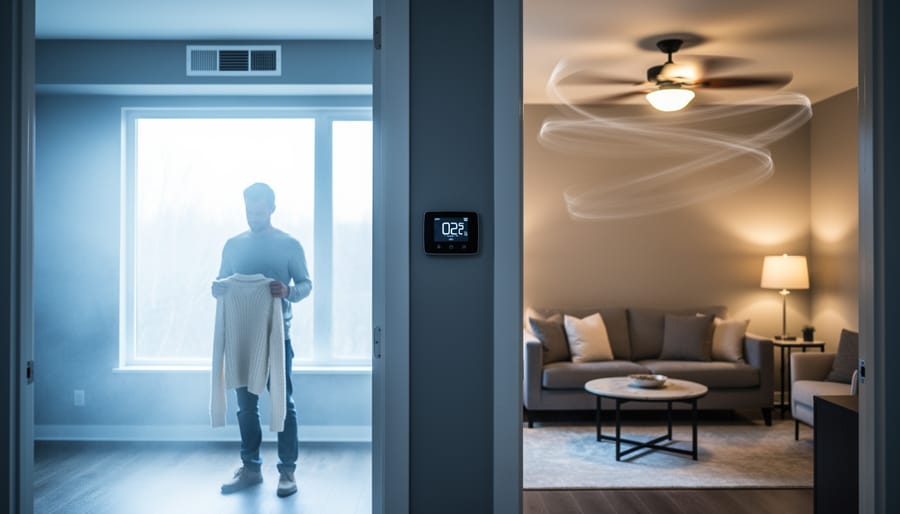
You’ve cranked the thermostat to 72 degrees, yet somehow you’re still pulling on a sweater in one room while sweating in another. The problem isn’t your HVAC system failing. It’s that air temperature tells only part of the story when it comes to indoor thermal comfort.
True comfort in your home depends on six interconnected factors: air temperature, radiant temperature from surrounding surfaces, humidity levels, air movement, your activity level, and what you’re wearing. When even one of these elements falls out of balance, your body notices immediately. That cold feeling near your windows on winter evenings? It’s radiant heat loss to the glass, not the thermostat lying to you. The stuffiness in your bedroom despite the AC running full blast? Likely poor air circulation combined with humidity issues your system can’t address.
Most homeowners focus exclusively on their thermostat, expecting it to solve every comfort problem. But your walls, floors, and ceiling are constantly radiating heat toward or away from your body. A room at 70 degrees with cold exterior walls feels completely different from the same temperature with well-insulated, warm surfaces. Similarly, still air at 72 degrees feels warmer than moving air at the same temperature, which is why ceiling fans work so effectively.
Understanding these dynamics changes everything about how you approach comfort in your home. Instead of fighting with your thermostat and watching energy bills climb, you can target the actual sources of discomfort. Some fixes take five minutes and cost nothing. Others require investment but transform how your home feels year-round. The key is knowing which factors are working against you and addressing them strategically, starting with the simplest solutions that often deliver surprising results.
What Indoor Thermal Comfort Actually Means
Thermal comfort isn’t just about setting your thermostat to 72°F and calling it a day. It’s that elusive feeling when you’re in a room and don’t notice the temperature at all, you’re not pulling on a sweater or peeling off layers, and your body isn’t working to regulate itself. You’re just comfortable.
Here’s why that’s trickier than it sounds: six different factors work together to create what you experience as comfort, and they all influence each other.
**Air temperature** is the obvious one, what your thermostat measures. But your body doesn’t just feel the air around you. **Radiant temperature** matters just as much, that’s the warmth or coolness coming from surfaces like walls, windows, and floors. Stand next to a large window on a winter day and you’ll feel cold even if the room’s air is warm, because you’re losing heat to that cold glass surface.
**Humidity** changes everything about how temperature feels. At 40% humidity, 75°F feels pleasant. At 70% humidity, that same temperature feels sticky and oppressive. In winter, bone-dry air at 72°F can feel chilly because your skin loses moisture rapidly.
**Air movement** explains why a slight breeze feels refreshing in summer but drafty in winter. Moving air strips away your body’s thin layer of warmth, which cools you down. Sometimes that’s exactly what you want; other times it’s the problem making you uncomfortable.
Then come the factors you control directly: **what you’re wearing** and **what you’re doing**. Lounging on the couch reading requires warmer conditions than cooking dinner or doing yoga. Your grandmother in a cardigan needs different conditions than your teenager in a t-shirt.
This is why two people in the same room can feel completely different. One person’s perfect is another person’s too warm. Your comfort sweet spot also shifts with the seasons, 68°F feels cozy in January but cool in July because your body acclimates over time.
The real challenge for homeowners is that most HVAC systems only control air temperature. They ignore radiant heat, humidity often drifts unmonitored, and airflow gets designed once during construction then forgotten. Understanding these six factors helps you identify what’s actually wrong when your home feels off, even when the thermostat claims everything’s fine.

The Hidden Culprits Making Your Home Uncomfortable
Temperature Imbalances Between Rooms
If your bedroom feels like a sauna while your home office is an icebox, you’re dealing with a classic thermal comfort problem. This temperature gap between rooms happens for three main reasons: poor airflow, inconsistent insulation, and uneven sun exposure.
Start with your HVAC system’s airflow. Most homes use a single thermostat to control multiple rooms, but the room with that thermostat sets the temperature for everything. If it’s in a shaded hallway, your sunny living room will overheat before the AC kicks on. Closed or partially blocked vents, undersized ductwork, and unbalanced dampers make this worse. Walk through your home and check that all vents are open and unobstructed by furniture.
Insulation gaps create hot and cold zones you’ll feel immediately. Rooms over garages or above unconditioned crawl spaces lose heat faster in winter. Exterior walls with poor insulation can’t hold temperature, especially on north-facing sides that never see sun. You can identify problem areas by touching walls on cold days, if one room’s walls feel noticeably colder than another’s, that’s your culprit.
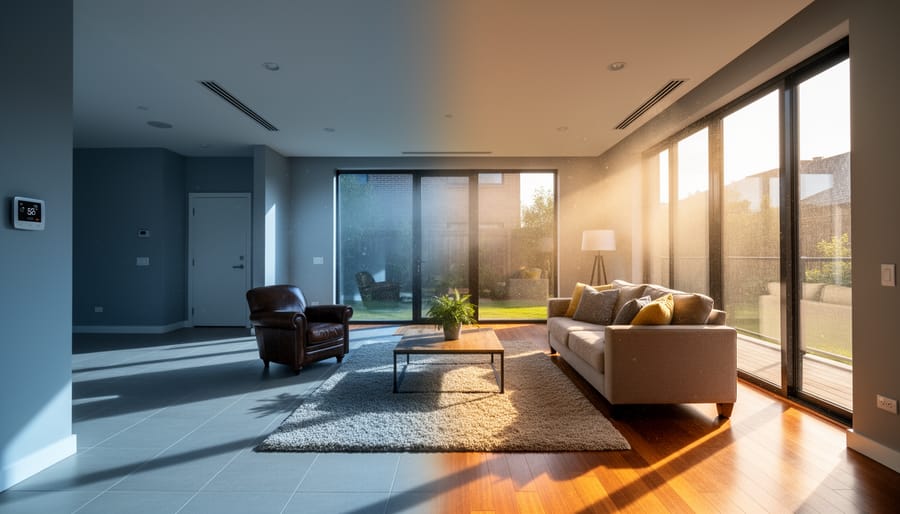
Sun exposure amplifies everything. South and west-facing rooms absorb intense afternoon heat in summer, while north-facing spaces stay cool year-round. East-facing bedrooms that feel perfect at night become ovens by mid-morning. Without window treatments or exterior shading, solar gain can create 10-15 degree differences between rooms in the same house.
The Humidity Problem No One Talks About
Your home might be the perfect 72 degrees, but if you’re still uncomfortable, humidity is probably the hidden culprit. Most homeowners obsess over their thermostat while completely ignoring the moisture levels in their air, which can make the exact same temperature feel like a sauna in July or a desert in January.
Here’s why humidity wrecks your comfort: humid air feels hotter because moisture prevents your sweat from evaporating, which is your body’s primary cooling mechanism. In winter, dry air pulls moisture from your skin and respiratory system, making you feel cold even when the room is warm. That scratchy throat, static electricity, and constant need to turn up the heat? All symptoms of low humidity stealing your comfort.
The stuffy feeling in summer happens when humidity climbs above 60%, making your home feel muggy and oppressive. You’ll crank the AC lower trying to compensate, which drives up energy bills without actually solving the problem. In winter, forced-air heating can drop indoor humidity below 20%, creating that bone-dry feeling that has you piling on blankets despite a warm thermostat reading.
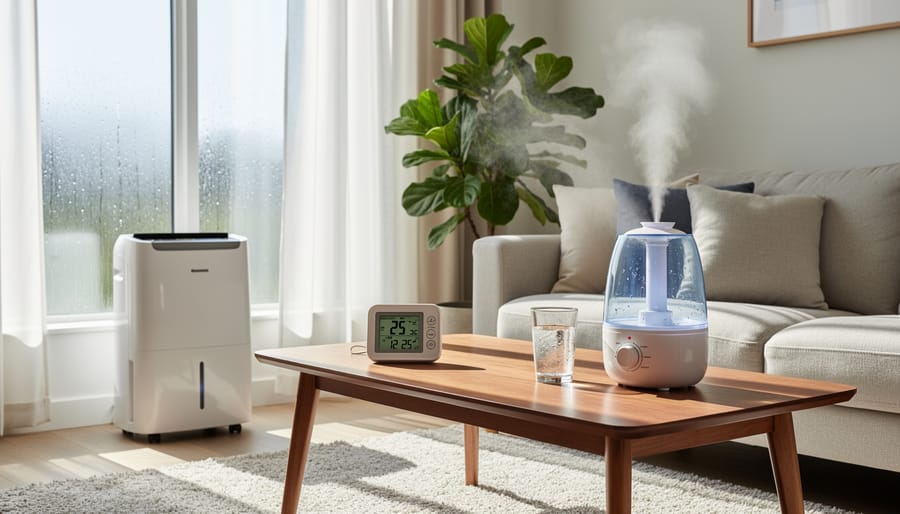
Grab a cheap hygrometer from any hardware store and check your actual humidity levels. You’ll probably discover your discomfort has nothing to do with temperature and everything to do with moisture. A $30 humidifier or dehumidifier often solves comfort problems that thousands in HVAC upgrades won’t touch.
Radiant Heat Loss and Gain
Your thermostat reads a comfortable 70°F, but you’re still reaching for a blanket on the couch or moving away from the windows. That’s radiant heat at work, and it’s one of the most overlooked factors affecting thermal comfort in your home.
Radiant temperature refers to the heat you absorb from or lose to the surfaces around you. Even when the air feels perfectly warm, a cold exterior wall, uninsulated window, or tile floor can pull heat directly from your body through thermal radiation. Stand next to a window on a winter night and you’ll feel distinctly colder than the thermostat suggests, even without a draft. That’s your body radiating heat toward the cold glass surface.
The reverse happens in summer. Walls baking in afternoon sun become heat radiators themselves, making rooms feel stuffy and uncomfortable even when the air conditioning is running. A west-facing brick wall can reach 140°F or higher, turning that side of your home into an oven.
Floor temperature matters more than most people realize because your feet are extremely sensitive to thermal transfer. Walking barefoot on tile or concrete can make a room feel 5-10 degrees colder than carpet or wood, regardless of what the thermostat says.
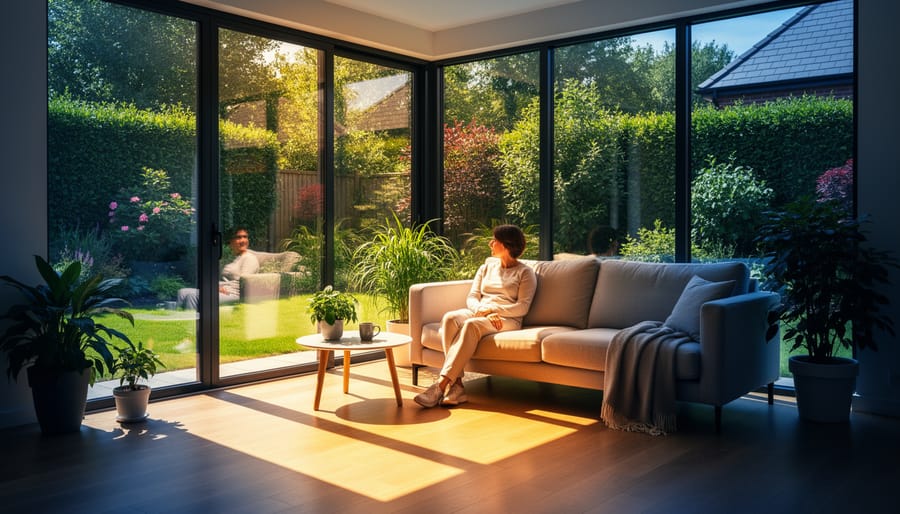
Large windows and glass doors create the biggest radiant comfort problems. They’re thermal weak spots that radiate cold in winter and heat in summer, affecting how comfortable you feel up to six feet away. Modern low-E windows help, but older single-pane glass turns entire walls into comfort killers that no amount of conditioned air can fully overcome.
How Indoor-Outdoor Integration Changes Everything
That stunning wall of glass doors opening to your patio might be Instagram-worthy, but it’s also working against your thermal comfort in ways most homeowners don’t anticipate. Hybrid indoor-outdoor spaces have become increasingly popular in 2026, yet they create thermal challenges that traditional rooms never face.
The physics are simple but unforgiving. Glass conducts heat roughly 10 times faster than an insulated wall, meaning your twelve-foot sliding door system bleeds warmth in winter and radiates heat in summer. Even high-performance windows with low-E coatings can’t match the insulating power of a properly built wall. When you commit to that one home feel that seamlessly connects inside and out, you’re trading some thermal efficiency for visual and spatial benefits.
Solar gain presents the most dramatic problem. A south-facing sunroom can swing 30 degrees warmer than the rest of your home on a sunny winter afternoon, then plummet once the sun sets. Your HVAC system struggles to keep up with these extreme temperature swings, often overcooling the main house to compensate for the overheated sunroom, or vice versa. The result is discomfort everywhere.
Thermal bridging compounds these issues. Where glass meets frame meets floor, heat flows freely along the continuous path of conductive materials. Stand near floor-to-ceiling windows on a cold day and you’ll feel the chill radiating from the glass and frames, even if the air temperature reads 72 degrees. Your body loses heat to these cold surfaces, making the space feel colder than the thermostat suggests.
Transition zones create their own headaches. That covered patio with ceiling fans and a fireplace exists in thermal limbo, neither fully conditioned nor outdoor space. Should you heat it? Cool it? Most homeowners end up with expensive propane patio heaters running while the air conditioning battles the open doors ten feet away.
Managing indoor comfort in these spaces requires different strategies than conventional rooms. Motorized shades programmed to close during peak sun hours help control solar gain. Separate HVAC zones for glass-heavy rooms prevent them from throwing off the whole house. Radiant floor heating counteracts the cold radiating from expansive windows. Ceiling fans become essential, not optional, to keep air moving and temperatures even.
The payoff is worth it for many homeowners. You just need to design and budget for the thermal realities upfront rather than discovering them after installation.
Practical Solutions to Improve Your Indoor Thermal Comfort
Quick Wins You Can Do This Weekend
Start with the changes that cost almost nothing but deliver immediate results. These weekend projects tackle thermal comfort issues without requiring professional help or major investment.
**Reverse your ceiling fans.** Most people forget fans have a winter setting. In summer, blades should spin counterclockwise to push air down and create a cooling breeze. In winter, switch to clockwise at low speed to pull cold air up and push warm air down from the ceiling. That small flip can make rooms feel 3-4 degrees warmer or cooler without touching the thermostat.
**Layer your window treatments strategically.** Cellular shades trap air in their honeycomb pockets, creating an insulating buffer against cold windows. Thermal curtains block radiant heat loss in winter and solar gain in summer. Close them at sunset in winter to trap warmth inside, and keep them closed during peak sun hours in summer. If you’re working toward seamless living with large glass walls, invest in automated shades that adjust throughout the day.
**Get a basic hygrometer** to monitor indoor humidity. These cost about $10-15 and reveal whether dry winter air or muggy summer conditions are sabotaging your comfort. Aim for 30-50% relative humidity year-round. A small humidifier or dehumidifier often solves comfort problems no amount of temperature adjustment can fix.
**Rearrange furniture away from exterior walls.** Move sofas and beds at least 6-12 inches from cold walls and drafty windows. The radiant cold from those surfaces creates discomfort zones even when room temperature reads fine.
**Seal air leaks with a simple draft test.** Hold a lit incense stick near windows, outlets, baseboards, and door frames on a windy day. Smoke movement reveals air infiltration spots. Address them with these quick fixes:
- Apply weatherstripping tape around door frames and window sashes
- Install foam gaskets behind outlet and switch plate covers on exterior walls
- Use rope caulk (removable for renters) to seal window gaps temporarily
- Place draft stoppers along door bottoms, especially on basement and attic entries
- Cover unused fireplace openings with magnetic vent covers
These five steps typically take 2-3 hours total and cost under $50 in materials. Most homeowners eliminate 10-20% of heating and cooling loss just by stopping air infiltration in obvious spots.
Smart Technology Integration for 2026
Smart thermostats have evolved beyond simple programmability. Modern systems use room sensors to track actual conditions where you spend time, not just at a single hallway location. These sensors detect temperature, humidity, and occupancy, automatically adjusting airflow to rooms that need it most. You’ll stop heating empty bedrooms while your living room stays cold.
Automated window treatments now integrate with weather forecasting and sun-tracking algorithms. Motorized blinds and shades close before afternoon sun turns your west-facing rooms into saunas, then reopen when temperatures moderate. The best systems coordinate with your HVAC, reducing cooling demand by blocking solar gain before it becomes a problem.
Air quality monitors add another dimension to comfort. Poor air quality makes spaces feel stuffy and uncomfortable even at ideal temperatures. Current monitors track VOCs, CO2, particulates, and humidity, triggering ventilation adjustments automatically. Some integrate with your HVAC to increase fresh air circulation when indoor air degrades.
Zoned HVAC systems remain the gold standard for whole-home comfort. Smart dampers in your ductwork direct conditioned air precisely where needed, while software integration ties everything together. Your thermostat, sensors, blinds, and ventilation operate as one coordinated system, learning your preferences and adjusting automatically. Expect installation costs from $2,000 for basic smart thermostats to $8,000-plus for comprehensive zoned systems, with most homeowners seeing 15-25% energy savings within the first year.
Bigger Investments That Pay Off
When quick fixes aren’t enough, these major upgrades deliver lasting improvements to thermal comfort. The right investment depends on your budget, timeline, and which problems bother you most.
**Wall and attic insulation** addresses the root cause of temperature swings. Adding blown-in insulation to walls costs $1.50-$3.00 per square foot, while attic upgrades run $1,000-$2,500 for most homes. You’ll notice steadier temperatures within days, and most homeowners recoup costs through lower energy bills in 3-5 years. If you have rooms that are always too hot or cold regardless of thermostat settings, insulation delivers the biggest bang for your buck.
**Window replacement** solves radiant heat loss and gain simultaneously. Modern double or triple-pane windows with low-E coatings cost $400-$1,200 per window installed, but they eliminate cold glass surfaces in winter and reduce solar heat gain in summer. The payback stretches to 8-12 years on energy savings alone, but the comfort improvement is immediate and substantial.
**Radiant floor heating** transforms how a room feels by warming surfaces instead of just air. Expect $10-$20 per square foot installed. While expensive upfront, radiant systems create unmatched comfort in bathrooms, kitchens, and basement spaces where cold floors are the main complaint.
| Improvement | Cost Range | Comfort Impact | Payback Period |
|---|---|---|---|
| Insulation upgrade | $1,500-$4,000 | High | 3-5 years |
| Window replacement | $4,000-$12,000 | Very high | 8-12 years |
| Radiant heating | $8,000-$15,000 | Extremely high | 15-20 years |
| Zoned HVAC system | $3,000-$7,000 | High | 5-8 years |
**Upgrading to a zoned HVAC system** costs $3,000-$7,000 but solves multi-room temperature imbalances permanently. Individual zone control means bedrooms stay cool while living areas stay warm, matching how you actually use your home.
Don’t tackle everything at once. Start with the upgrade addressing your biggest discomfort, then build from there as budget allows.
Balancing Comfort and Energy Efficiency
The reality nobody wants to hear: perfect comfort at zero cost doesn’t exist. Every degree warmer in winter and cooler in summer shows up on your utility bill. But here’s what changed in 2026, energy costs keep climbing while smart technology got cheaper. That shift means you can actually maintain comfort while cutting waste.
Start with the 20-degree rule. In winter, every degree you lower your thermostat saves roughly 3% on heating costs. That doesn’t mean freezing in a cold house. It means using radiant heat strategically. A well-placed space heater in the room you’re actually using beats heating your entire home to 72 degrees. Layer with throws and slippers instead of cranking the dial.
Summer works the same way. Raising your AC setpoint from 68 to 72 degrees can cut cooling costs by 12-15%. Compensate with ceiling fans, which use a fraction of the energy an AC unit does. Moving air at 75 degrees feels cooler than still air at 72 degrees, and you’ll see the difference in your bill.
Programmable schedules matter more than most people realize. Nobody needs a perfectly heated bedroom at 2 PM when they’re at work, yet that’s exactly what fixed thermostats deliver. Modern smart thermostats learn your patterns and adjust automatically. Set occupied zones to comfortable temperatures and let empty spaces coast a few degrees off.
Windows are your biggest energy leak and your best free resource. Close blinds on west-facing windows before the afternoon sun hits in summer. Open them on south-facing windows during winter days for free solar heating. This costs nothing and works immediately.
The sustainability angle isn’t just about saving money, though 2026 utility rates make that compelling enough. Better thermal management means lower carbon emissions. Seal air leaks, add insulation where it matters most, and zone your comfort. You’re not choosing between comfort and efficiency. You’re choosing smarter comfort that doesn’t waste energy keeping empty rooms perfect.
Indoor thermal comfort isn’t about hitting the perfect temperature on your thermostat. It’s about understanding how air temperature, humidity, radiant heat, and air movement work together to create spaces where you actually want to spend time. Your discomfort has real, identifiable causes, whether it’s humidity making your living room feel muggy, cold floors radiating chill through your whole body, or poor airflow creating hot spots and cold zones.
The good news? You don’t need to overhaul your entire home tomorrow. Start with the quick wins: adjust your ceiling fans, add thermal curtains, seal obvious drafts, or grab a hygrometer to monitor humidity levels. These weekend projects often deliver noticeable improvements for minimal investment. From there, you can layer in smart technology or tackle bigger upgrades like insulation or zoned HVAC when the time and budget align.
Remember that comfort is personal. What feels perfect to you might feel too warm or too cool to someone else in your household. That’s normal. The goal isn’t perfection; it’s progress toward a home that works for your family’s needs without wasting energy or money. Take it one room at a time, one solution at a time, and you’ll get there.