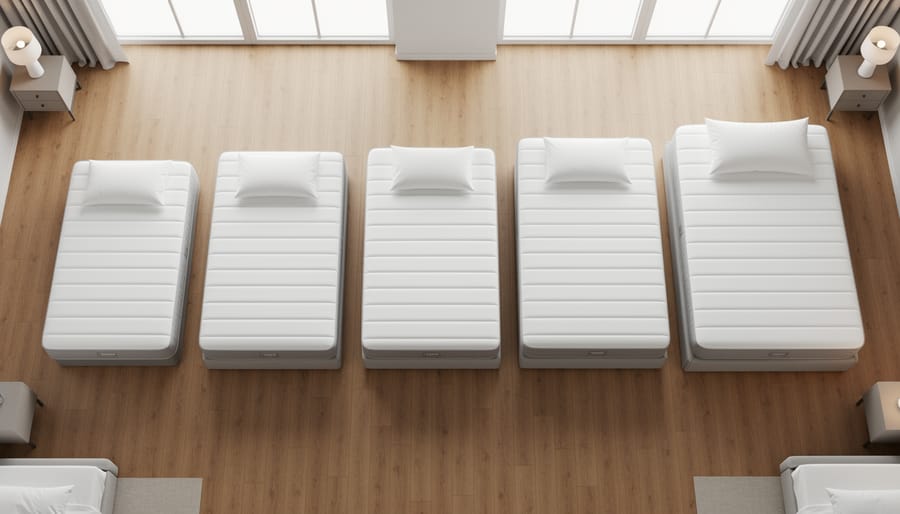
Stop Buying the Wrong Mattress Size for Your Bedroom
Measure your bedroom before falling in love with a mattress online. Walk into any furniture store and you’ll notice mattresses don’t follow a universal sizing system—what one brand calls a “Queen” might differ by several inches from another. Grab a tape measure and record your current bed frame dimensions, doorway widths, and the space around where your mattress will sit. You’ll need at least two feet of walking space on each side for comfortable movement and making the bed.
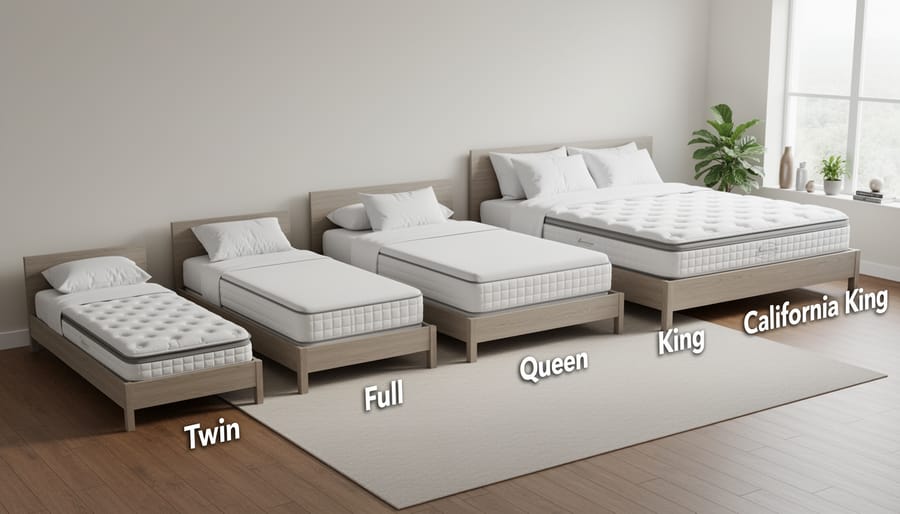
Standard mattress sizes range from Twin (38″ x 75″) to California King (72″ x 84″), but your body dimensions and sleeping habits matter more than general recommendations. If you’re over six feet tall, prioritize length over width by choosing Twin XL, Queen, King, or California King options that offer 80-84 inches of stretch-out room. Couples should calculate based on personal space needs—a standard Queen gives each person just 30 inches of width, equivalent to a crib mattress, while a King provides a more generous 38 inches per person.
Match your mattress choice to your bed frame type and room layout. Platform beds, adjustable bases, and traditional box springs each have specific height and support requirements that affect which mattress size works best in your space.
Standard Mattress Sizes Explained
Twin and Twin XL
Twin mattresses measure 38 inches wide by 75 inches long, while Twin XL extends to 80 inches in length—the same length as a Queen. These compact sizes are perfect for children’s bedrooms, making them ideal companions to children’s room furniture as your little ones grow. Single adults, especially taller individuals who appreciate the extra legroom of a Twin XL, also find these sizes practical for smaller living spaces.
Twin mattresses work beautifully in guest rooms, dorm rooms, and apartments where space is at a premium. You’ll need at least a 7×10 foot room for comfortable furniture placement around the bed. Consider pairing two Twin XLs side-by-side with a converter kit to create a flexible King-sized sleep space—a clever solution for guest rooms that need to accommodate both couples and individual visitors.
Full (Double)
The Full or Double mattress measures 54 inches wide by 75 inches long, making it a solid choice for single adults who want extra sleeping space or teens transitioning from a twin. It’s perfect for smaller bedrooms, apartments, and guest rooms where you need to maximize floor space while still offering comfortable accommodations.
While technically wide enough for two people, couples may find a Full mattress cramped, especially if either partner is taller than 6 feet or prefers more personal space during sleep. Each person gets just 27 inches of width—less than a twin bed. If you’re sharing with a partner regularly, consider sizing up for better sleep quality. However, for occasional guest room use or young couples in tight quarters, a Full can work as a budget-friendly temporary solution before upgrading to a larger size.
Queen
The queen mattress measures 60 inches wide by 80 inches long, making it the most popular mattress size in America—and for good reason. It strikes the perfect balance between sleeping space and bedroom flexibility, offering couples enough room to sleep comfortably without overwhelming your master bedroom.
This size gives each sleeper roughly 30 inches of personal space, which is considerably more generous than a full mattress. You’ll have plenty of room to stretch out, shift positions throughout the night, and accommodate pets or kids who occasionally join you for weekend morning snuggles.
Queen mattresses work beautifully in bedrooms that are at least 10 by 10 feet, though 10 by 12 feet is ideal for comfortable movement around the bed. They’re also budget-friendly compared to king sizes—you’ll save on both the mattress itself and bedding accessories like sheets, comforters, and bed frames.
If you’re a single sleeper who loves extra space or a couple in a moderately-sized bedroom, the queen hits the sweet spot. It’s also easier to move through doorways and up stairs compared to larger sizes, making future relocations much simpler.
King and California King
A King mattress measures 76 inches wide by 80 inches long, while a California King stretches to 72 inches wide by 84 inches long. The key difference? Kings offer more width, perfect for couples who want extra elbow room, while Cal Kings provide additional length, ideal for taller sleepers.
Your bedroom should be at least 12 feet by 12 feet for a standard King, though 13 feet by 13 feet feels more comfortable. California Kings work best in rooms that are 12 feet by 14 feet or larger, accommodating that extra length without cramping your walking space.
Choose a King if you’re sharing with a partner or pets and want maximum side-to-side space. It’s also easier to find bedding and accessories since it’s the more common size. Opt for a California King if you or your partner are over 6 feet tall and need that extra legroom, or if your bedroom layout favors a narrower but longer footprint. Keep in mind that Cal King sheets and bedding can be slightly harder to find and may cost a bit more.
Specialty Sizes
Beyond standard residential sizes, you might need something more specialized. RV mattresses come in unique dimensions to fit compact spaces—think RV Queen at 60″ x 75″ or RV King at 72″ x 80″, both shorter than their traditional counterparts. These work perfectly for mobile living situations where every inch counts.
Split King mattresses are gaining popularity, especially for couples with different sleep preferences. This setup consists of two Twin XL mattresses side by side, creating a King-sized sleeping surface where each person can adjust their side independently—ideal if you’re integrating adjustable bases or smart sleep technology.
Custom sizes are also available through many manufacturers if you have an antique bed frame, a uniquely shaped bedroom, or specific accessibility needs. Just be prepared for higher costs and limited bedding options. When going custom, always measure twice and order once, keeping detailed records of your exact dimensions for future bedding purchases.
How to Choose the Right Mattress Size for Your Space
Measuring Your Bedroom
Before you fall in love with that king-size mattress, let’s make sure it’ll actually fit in your space. Grab a tape measure and follow these simple steps to avoid buyer’s remorse.
Start by measuring your room’s length and width at the widest points. Write these numbers down—trust us, you’ll forget them. Next, measure the clear floor space where your mattress will go, noting the distance from walls to any obstacles like radiators or built-in shelving.
Now here’s where people often trip up: check your doorways and hallways. Measure the width of your bedroom door, any hallway turns, and stairwells if you’re on an upper floor. Most mattresses can bend slightly during delivery, but you’ll need at least 30 inches of clearance for standard sizes and 38 inches for king mattresses.
Don’t forget to account for your existing or planned furniture. Leave at least 24 inches of walking space on each side of the bed for comfortable movement. Mark the positions of windows, outlets, and light switches on a quick sketch—you’ll want easy access to these.
Pro tip: Use painter’s tape on your floor to outline your potential mattress dimensions. This visual trick helps you see exactly how much space you’re working with.
The 2-Foot Rule
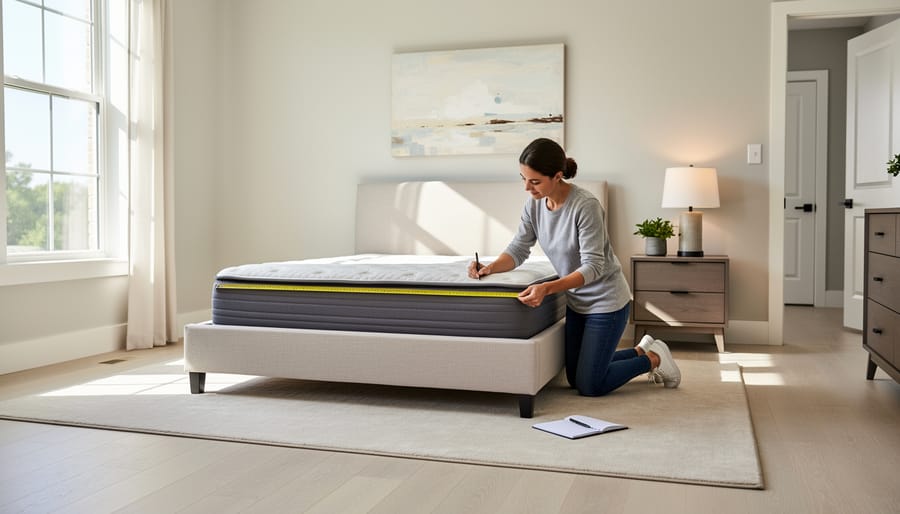
Give yourself room to breathe with the 2-foot rule. This simple guideline suggests leaving at least 24 inches of clearance on each side of the bed and at the foot. This spacing lets you move comfortably around your bedroom, make the bed without awkward reaching, and access nightstands with ease.
For smaller bedrooms, you can reduce this to 18 inches minimum, but you’ll notice the difference in daily convenience. Measure your room dimensions and subtract your mattress size plus the recommended clearances to see what truly fits. If you’re left with cramped walkways, consider downsizing your mattress choice.
Pro tip: Use painter’s tape on your floor to map out your bed’s footprint plus the 2-foot perimeter before purchasing. Walk around it for a day to test how it feels in real-world use.
Room Size Recommendations
Your mattress needs room to breathe, and so do you! Before committing to a larger mattress, make sure your bedroom can comfortably accommodate it. For a twin or twin XL, plan for at least a 7′ x 10′ room. A full mattress fits nicely in a 10′ x 10′ space, while queens need approximately 10′ x 10′ to 10′ x 12′ for comfortable movement around the bed. King-sized mattresses require a more spacious 12′ x 12′ room minimum, and California kings work best in rooms that are at least 12′ x 12′ or larger, ideally with more length than width. These measurements account for walking space, nightstands, and dressers. Remember to measure doorways and hallways too—you’ll need to get that mattress into your room! A quick DIY tip: use painter’s tape to outline the mattress footprint on your floor before purchasing to visualize the actual space it’ll occupy.
Matching Your Mattress to the Right Bed Frame
Bed Frame Size Standards
Here’s the good news: bed frames are designed to match standard mattress sizes, making it relatively straightforward to pair them together. However, it’s important to understand that while a queen bed frame should fit a queen mattress, slight variations exist between manufacturers.
Most reputable bed frame makers follow industry standards closely, but you might encounter differences of an inch or two in frame dimensions. This is especially true when shopping for secondhand bed frames or vintage pieces, where older manufacturing standards may differ from today’s specifications.
Before purchasing, always measure your existing frame’s interior dimensions and compare them to your new mattress specifications. Leave a small gap of about half an inch on each side for bedding to tuck in comfortably. If you’re buying both the frame and mattress together, confirm they’re from the same size category and check return policies just in case the fit isn’t perfect.
Platform Beds vs. Box Springs
Your bed frame choice significantly impacts both mattress compatibility and overall bed height. Platform beds feature built-in support slats, eliminating the need for a box spring and creating a lower profile—ideal for modern aesthetics and smaller bedrooms. These work with most mattress types, especially memory foam and latex. Traditional box springs sit on a bed frame and add 8-10 inches of height, creating a classic look that suits innerspring mattresses particularly well. A quality bed frame provides essential stability regardless of your choice. Metal bed frames offer durability and often accommodate both setups. Before purchasing, measure your desired bed height and confirm your mattress manufacturer’s foundation requirements—some warranties require specific support types.
Adjustable Base Considerations
Adjustable bases typically accommodate standard mattress sizes, but verify compatibility before purchasing. Most split king configurations (two Twin XL mattresses) work best for couples wanting independent positioning. Check the base’s weight capacity—memory foam and hybrid mattresses are heavier than traditional innerspring options. Ensure your mattress is flexible enough to bend with the base’s movement; most modern foam and latex mattresses adjust well, while older innerspring models may resist. Measure the base’s dimensions when fully raised, as it requires additional clearance from walls and nightstands. Consider wireless remotes and under-bed lighting features when planning your bedroom layout and electrical outlet placement.
Finding the Right Size for Your Sleeping Situation
Solo Sleepers
For single sleepers, your ideal mattress size depends on a few key factors. If you’re under 6 feet tall and have limited bedroom space, a Twin (38″ x 75″) works well for kids or guest rooms. However, most adults appreciate the extra elbow room of a Twin XL (38″ x 80″), which accommodates taller individuals comfortably.
A Full mattress (54″ x 75″) offers generous width for those who move around during sleep or prefer spreading out. It’s perfect for smaller master bedrooms where a queen might feel cramped. Consider your sleeping style too—stomach and back sleepers typically need less space than side sleepers who shift positions throughout the night.
Before deciding, measure your bedroom to ensure at least 24 inches of walking space on each side. Think about mattress comfort considerations alongside size, as the right dimensions paired with proper support create your ideal sleep environment. If space allows, sizing up provides room for growth and flexibility.
Couples
When sharing a mattress, you need enough room for both people to sleep comfortably without feeling cramped. A simple way to test if a mattress is big enough is the elbow test: lie down together with your hands behind your heads. If your elbows touch, you’ll want to size up.
For couples, a queen mattress (60 inches wide) gives each person about 30 inches of personal space—roughly the width of a crib mattress. If either of you is a restless sleeper, sprawls out, or is taller than 6 feet, consider upgrading to a king (76 inches) or California king (72 inches). Active sleepers who toss and turn throughout the night benefit from that extra buffer zone to avoid disturbing their partner.
Think about your sleep styles too. Do you cuddle close or prefer personal space? Does one person run hot while the other gets cold? A larger mattress accommodates different temperature preferences with separate blankets and gives fidgety sleepers room to move freely without encroaching on their partner’s rest zone.
Co-Sleeping with Kids or Pets
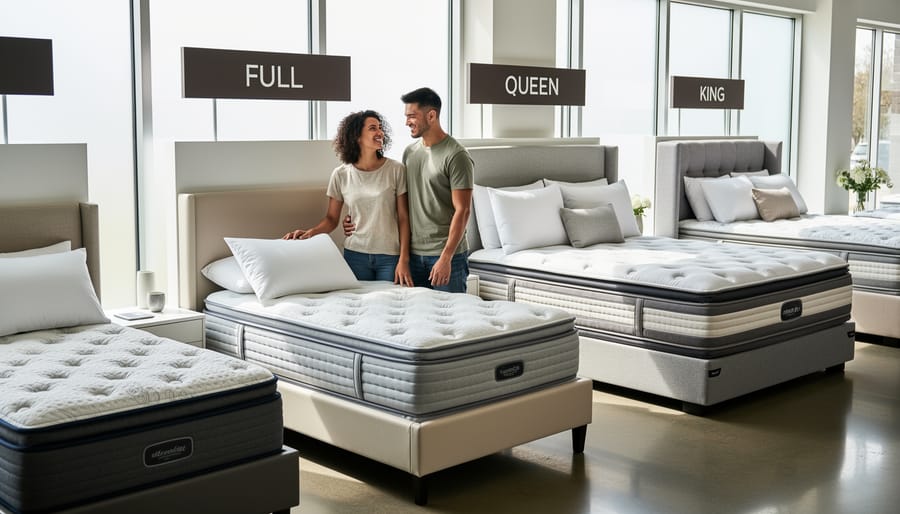
If you’re sharing your bed with kids or pets regularly, consider sizing up for everyone’s comfort. A queen works for one adult plus a toddler or small pet, but a king or California king is ideal for families with multiple children or larger dogs. The extra space reduces disruptions from nighttime movements and gives everyone room to spread out. For households with growing children, investing in a king-sized mattress now can accommodate years of bed-sharing. If space allows, a king provides approximately 38 inches per person when shared by two adults and one child, compared to just 30 inches each on a queen.
Height Considerations
If you’re taller than 6 feet, it’s time to consider an extra-long mattress. Standard mattresses measure 75 inches in length, which doesn’t leave much wiggle room for taller folks. Twin XL, California King, and some specialty sizes offer 80 inches of length—giving you that crucial extra 5 inches for comfortable sleeping without your feet hanging off the edge. A good rule of thumb: choose a mattress that’s at least 6 inches longer than your height. This ensures you can stretch out fully and wake up refreshed rather than cramped.
Bedding and Accessory Sizing
Sheet Sizing
Finding the right fitted sheets means paying attention to your mattress depth, not just its length and width. Standard mattresses typically measure 7-9 inches deep, while pillow-tops and luxury models can reach 14-18 inches. Before shopping, measure your mattress from the bottom edge to the top surface, including any pillow-top layer.
Fitted sheets list their pocket depth on packaging, which indicates how deep the corner pockets stretch. For a secure fit, choose sheets with pockets 2-4 inches deeper than your mattress. A 12-inch mattress works well with 14-16 inch pocket sheets, while a 16-inch mattress needs 18-20 inch pockets. Too shallow and corners pop off during the night; too deep and excess fabric bunches underneath.
Pro tip: If you’re between sizes, go deeper rather than shallower. The extra fabric tucks neatly under your mattress, while tight sheets struggle to stay in place.
Comforters and Duvets
Your comforter or duvet should be larger than your mattress to ensure proper coverage and a polished look. As a general rule, choose bedding that’s 12 to 20 inches wider and longer than your mattress dimensions. For example, a queen mattress measures 60 by 80 inches, so look for a comforter that’s at least 86 by 92 inches. This overhang creates an inviting, luxurious appearance while keeping you warm throughout the night. Keep in mind that comforter sizes aren’t as standardized as mattresses, so always check product dimensions before purchasing. If you prefer a minimalist look with less overhang, go with smaller measurements, but ensure the bedding still tucks comfortably under your mattress edges.
Mattress Protectors and Toppers
Once you’ve chosen your mattress size, don’t forget your accessories need to match perfectly too. Mattress protectors and toppers are sold by standard mattress dimensions, so a Queen protector fits a Queen mattress. Always double-check your exact mattress measurements before buying, since some specialty or pillow-top mattresses run deeper than standard heights. Most protectors accommodate mattresses up to 18 inches deep, but measure your mattress depth to ensure a snug fit that won’t slip off during the night.
Common Mattress Sizing Mistakes to Avoid
Even the savviest shoppers make sizing slip-ups that can lead to uncomfortable nights and costly returns. Here are the most common pitfalls to sidestep:
Forgetting to measure your room first is mistake number one. That king-size mattress might look perfect in the showroom, but cramming it into a small bedroom leaves no space for nightstands or easy movement. Always measure your room dimensions before falling in love with a larger size.
Assuming your current bed frame fits standard sizes can backfire. Older frames or specialty pieces might have non-standard dimensions, leaving gaps or overhang. Grab your tape measure and check the frame’s interior dimensions before ordering.
Not accounting for bedding costs is an easy oversight. Upgrading from a queen to a king means investing in new sheets, comforters, and mattress protectors—expenses that add up quickly. Factor these costs into your budget from the start.
Many couples automatically default to a king without considering their bedroom layout or sleeping habits. If you’re working with limited space, a queen might actually provide better room flow while still offering comfortable sleep for two.
Overlooking mattress height is another frequent error. Today’s mattresses, especially those with pillow-tops or multiple foam layers, can be significantly taller than traditional models. Make sure your fitted sheets accommodate the depth, and verify that getting in and out of bed remains comfortable, especially for children or older adults.
Choosing the right mattress size isn’t just about fitting a bed into your room—it directly impacts your sleep quality, comfort, and overall bedroom functionality. Taking the time to measure your space carefully and honestly assess your needs will save you from costly returns and ensure you wake up refreshed for years to come. Remember to account for both floor space and bedroom traffic flow, and don’t forget to verify that your mattress matches your bed frame and bedding. Whether you’re shopping for yourself, a growing child, or a guest room, the perfect mattress size is out there waiting for you. Grab your measuring tape, consider your unique sleeping habits and room dimensions, and make a confident choice that transforms your bedroom into the restful retreat you deserve.